
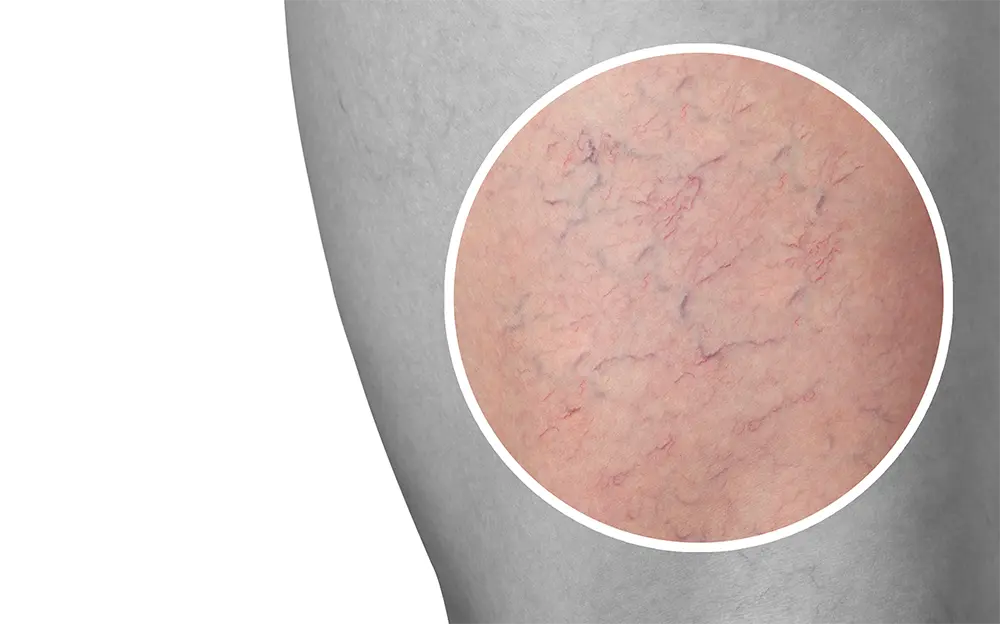

Spider veins do not appear in just one place. While most people associate them with the legs, visible veins can also develop on the face and hands. That often leads to a common question during consultation. If sclerotherapy works so well for leg veins, can it be used everywhere?
The answer is more nuanced than a simple yes or no. Sclerotherapy is highly effective in certain areas, but not all visible veins behave the same way. The size, depth, and function of the vessel all influence whether it is an appropriate treatment option.
Understanding where sclerotherapy works best, and where other treatments may be safer or more effective, is an important part of making the right decision.
Why Treatment Varies by Area
Veins are not uniform across the body. The vessels in the legs experience different pressure, flow patterns, and structural stress compared to those in the face or hands. These differences matter because sclerotherapy relies on controlled closure of a targeted vein.
In the legs, many of the visible veins being treated are part of a superficial network that can be safely redirected without affecting overall circulation. In more delicate areas, especially the face, the vascular system is more complex and closely tied to critical structures.
Because of that, the same treatment approach is not always appropriate across different parts of the body.
Sclerotherapy for Legs
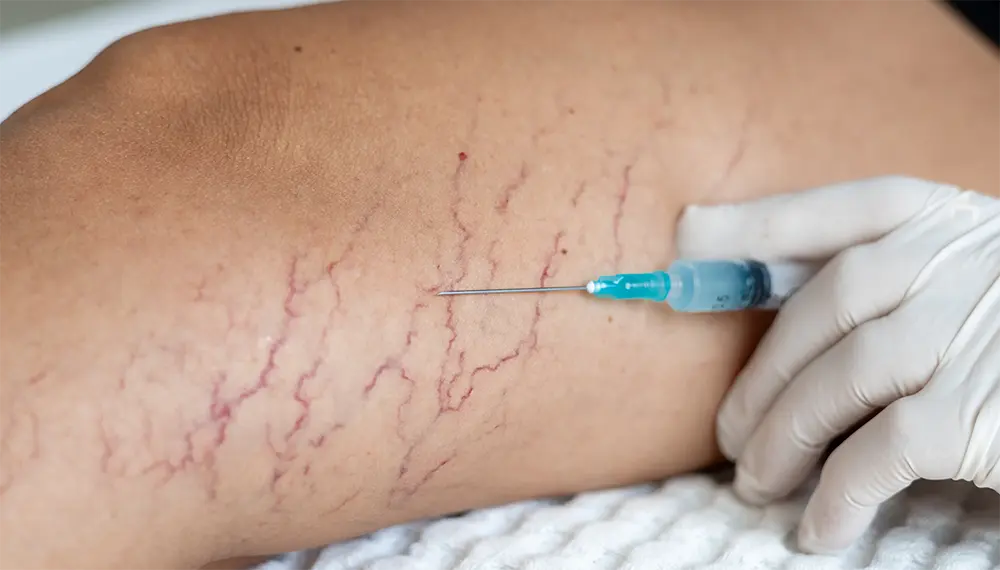
The legs are the most common and most studied area for sclerotherapy. Spider veins and small reticular veins in this region respond well because they are typically superficial and not essential to overall blood flow.
When a sclerosant is injected into these veins, the body is able to reroute circulation efficiently through deeper, healthier vessels. Over time, the treated veins fade as they are reabsorbed.
This is one reason sclerotherapy has remained a standard treatment for leg veins. Clinical literature consistently supports its use for telangiectasias and small superficial veins in the lower extremities.
It is also where the most predictable cosmetic improvement tends to occur, especially when treatment is planned appropriately and performed in stages when needed.
Sclerotherapy for the Face
Facial veins are a different category entirely. The vessels in the face are often smaller, more delicate, and located in areas where blood flow connects to deeper vascular structures.
Because of this, sclerotherapy is generally not the first-line treatment for most facial veins. In many cases, light-based therapies such as laser or broadband light are preferred. These treatments target the vessel without introducing an injectable solution into an area where precision is more critical.
There are select situations where sclerotherapy may be considered for specific facial veins, but this requires careful evaluation and advanced expertise. The margin for error is significantly smaller, and treatment decisions must prioritize safety over convenience.
For most patients, visible facial veins are better managed with non-injection approaches that are designed for that region.
Sclerotherapy for Hands
The hands present a more nuanced situation. Prominent veins in the hands are often a normal anatomical feature, especially as skin becomes thinner with age. In some cases, patients may want to reduce the appearance of these veins for cosmetic reasons.
Sclerotherapy can be used in the hands, but it is approached with caution. The veins in this area play a more visible role in normal circulation, and overly aggressive treatment can affect both appearance and function.
In many cases, providers focus on selective treatment rather than widespread vein removal. The goal is to soften the appearance while maintaining a natural look and preserving healthy blood flow.
For some patients, alternative approaches such as dermal fillers to restore volume in the hands may be discussed instead of or alongside vein treatment.
Why Proper Evaluation Matters
One of the most important parts of sclerotherapy is not the injection itself, but the decision-making that comes before it. Treating veins in different areas requires an understanding of anatomy, circulation, and how the body will respond after the vessel is closed.
Clinical guidelines emphasize the importance of identifying the type of vein being treated and ruling out underlying venous disease when necessary. This is especially important in areas where treatment carries higher risk or where alternative approaches may be more appropriate.
A consultation allows for that level of evaluation. It ensures that treatment is not only effective, but also appropriate for the specific area being addressed.
Setting Realistic Expectations
Patients often come in assuming that all visible veins can be treated the same way. In reality, each area of the body responds differently, and the safest approach is not always the most aggressive one.
Leg veins tend to respond well to sclerotherapy, often with gradual and noticeable improvement over time. Facial veins are usually better treated with light-based technology. Hand veins can be treated in select cases, but require a more conservative and individualized approach.
Understanding these differences helps avoid unnecessary risk and leads to more natural-looking results.
A More Thoughtful Approach to Vein Treatment
Sclerotherapy is a powerful tool, but like any medical treatment, it works best when it is used in the right context. The goal is not to apply the same solution everywhere, but to choose the right treatment for each area.
At Covet Med Spa, that approach is built into the consultation process. Every treatment plan is based on anatomy, safety, and long-term outcomes rather than a one-size-fits-all method.
A Clear Next Step
If you are noticing visible veins on your legs, face, or hands, the next best step is a professional evaluation. This allows you to understand what type of veins you are seeing and which treatments are appropriate for that area.
Sclerotherapy may be the right option, but in some cases, another approach will lead to better results.
Book your consultation today at Covet Med Spa to find out if sclerotherapy is right for you.
References
- Beneat, A., et al. (2025). Sclerotherapy. StatPearls Publishing.
- Mayo Clinic Staff. (2025). Sclerotherapy. Mayo Clinic.
- Rabe, E., Breu, F. X., Cavezzi, A., et al. (2014). European Guidelines for Sclerotherapy in Chronic Venous Disorders. Phlebology.
- Duffy, D. M. (2010). Sclerosants: A Comparative Review. Dermatologic Surgery.
- Goldman, M. P., & Weiss, R. A. (2012). Treatment of Facial Telangiectasia. Journal of Cosmetic Dermatology.ew. Phlebology.